

Not To Scale Welcomes Jovardi for US Representation
October 19, 2026
![Two people stand in front of a large "WE [heart] PITCHING" sculpture in a lively city plaza. This scene, featured in We Love Pitching Part 1, captures the creative buzz highlighted by Stash Media’s guest editorial. Frame from Stash Magazine article.](https://www.stashmedia.tv/wp-content/uploads/We-Love-Pitching-Part-1-Guest-editorial-by-Claus-Cibilis-_-STASH-MAGAZINE-960x540.jpg)
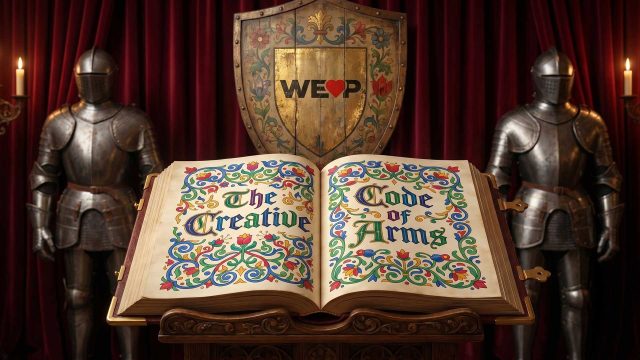
Part 4 of Claus Cibils’ We Love Pitching series of editorials introduces The Creative Code Of Arms (CCOA) – a living framework for testing and adjusting creative pitching practices as change continues and new frictions emerge.
Think of your favorite film, or that one Super Bowl commercial that lives in your head rent-free. Those ideas were developed, challenged, refined, and approved. There was pre-production, a shoot, design, animation, post-production, and endless revisions.
But before any of that, someone had to win the right to make it. That only happens through pitching, usually long before the party even begins.
Pitching isn’t optional. It’s infrastructure. The mechanism that decides who gets to work and who doesn’t. A cog in the procurement machine, business decision-making first, and only then a creative playground. Before it’s creative, it’s a decision.
“Pitching isn’t optional. It’s infrastructure. The mechanism that decides who gets to work and who doesn’t.”
Pitching is built into how most industries operate. In advertising, however, it has gradually become a loaded word. A shared discomfort, a mix of anticipation and tension. Excitement for some, dread for others. Clients, agencies, studios, artists – the feeling doesn’t discriminate.
Over time, urgency and volume became the default, and power imbalance became part of the routine. Implicit rules are shared by everyone involved. When no common standards exist, misunderstandings multiply, and tension becomes part of the culture.
The previous WLP articles mapped how the pitching system has gradually drifted into its current shape. Now, the Creative Code of Arms offers a framework to bring clarity to the process.

Rather than treating pitching as a necessary evil or a test of endurance, the CCOA frames it as a structured exchange. One that becomes more transparent, sharper, fairer, and more sustainable when expectations are made explicit.
We need to look at pitching as a full system, not a single presentation. It includes everything from briefing and compensation to transparency, trust, feedback, collaboration, and time. These are not abstract values, but recurring pressure points that shape how pitches are experienced and how ideas survive them.
“The Creative Code Of Arms is a living framework, not a dogma or a fixed set of rules carved in stone. It evolves through use, tested and adjusted as practices change and new frictions emerge.”
This framework is not meant to fuel debate or assign blame. Its role is to align expectations early, surface uncomfortable conversations before they become problems, and reduce the silent friction that accumulates throughout the process. It was built by people who understand the value of a fair fight.
Each code isolates a failure we have quietly normalized.
• In the Brief We Trust
• Collaborate, Collaborate, Collaborate
• Trust No One
• Keepin’ It Real
• Gotta Pay the Bills, Y’all
• Hold the Line
• Sharing Is Caring
• Protect Ya Neck
• Be Kind, Rewind
• Burn Down the House
• The Winner Takes It All
The CCOA is a living framework, not a dogma or a fixed set of rules carved in stone. It evolves through use, tested and adjusted as practices change and new frictions emerge.
Each principle will be explored individually in the articles to come. For now, the questions remain open: What should already be standard, but still isn’t? Which habits have we learned to accept as inevitable?
The goal is to create the conditions where the best ideas can win. If everyone contributed to the drift, everyone can help recalibrate the system. But every system has a starting point. In pitching, everything begins with the brief.
Follow Claus on LinkedIn and Instagram.
WE LOVE PITCHING: Let’s change the way we play the game.
DISCLAIMER: All images are AI-generated. If it feels real, uncomfortable, or a little ridiculous, it’s intentional. Artificially made. Human crafted.